Updated 25 November 2026. The housing bill is still before Parliament, and this post will be revised when the joint committee reports. It is general information, not legal advice.
Under the law in force today, a home rated F for energy performance cannot be let on a new lease in mainland France from 1 January 2028. The same applies when an existing lease is renewed or tacitly renewed (Ministry of Ecology). That is 13 months away.
Parliament is now arguing over whether that date survives. On 17 November 2026 the Assemblée nationale voted 108 to 102 for an amendment that deletes the rental-ban calendar (NosParlementaires). On 24 November it adopted the housing bill with that amendment in it, by 362 votes to 118. The government opposed the amendment and is counting on the joint committee of deputies and senators to remove it before final adoption, which it wants by the end of the year (LCP).
If you own thirty flats, or manage three hundred for other landlords, you do not know which rule will apply in 13 months. You do not need to know. You need a per-unit model that answers "fix, sell or hold" under each version of the rule, and that re-runs in minutes when the rule changes. That is a data problem, and a good fit for AI with some unglamorous engineering around it.
This post covers the law first, then the build.
What the law says today
Until a new law is promulgated, the calendar set by the 2021 Climate and Resilience Act applies. A home must reach a minimum class on its energy certificate to count as "decent", and only a decent home can be let (Ministry of Ecology). The certificate is the DPE (diagnostic de performance énergétique), which grades homes from A to G. Homes in classes F and G are the passoires thermiques, or thermal sieves, of French headlines.
The minimum rises in four steps:
- Since 1 January 2023: under 450 kWh/m² a year of final energy.
- Since 1 January 2025: class F or better, so G is excluded.
- From 1 January 2028: class E or better, so F is excluded. This step is contested in Parliament.
- From 1 January 2034: class D or better, so E is excluded. This step is contested too.
Four details matter more than the dates.
- The rule bites lease by lease. It applies to new leases and to leases renewed or tacitly renewed after each date, not to leases in mid-term. An unfurnished lease runs three years when the landlord is an individual and six when it is a company. A furnished lease runs one year (PAP). Two F-rated flats in the same building can therefore hit the rule years apart.
- Enforcement runs through the tenant and the judge. There is no automatic fine (Hello Watt). A tenant can ask a civil judge to order works, to cut or suspend the rent, and to suspend the lease term until the works are done.
- Rents on F and G homes are already frozen. Since 24 August 2022 there has been no increase between tenants, at renewal or through annual indexation. The freeze lifts only when a new DPE shows class E or better.
- Co-owned buildings get a partial shield. In a copropriété, a judge cannot order works if the landlord shows they pushed for them and the required class still could not be reached. The shield limits what a judge can order. It does not lift the rent freeze.
The rule covers furnished and unfurnished homes let as a main residence. Tourist lets fall outside it.
Three versions of 2028
The housing bill ("Relance logement") is on an accelerated procedure: one reading per chamber, then a joint committee. Three versions of the rule are on the table.
| Scenario | Where it comes from | What it means for an F-rated home |
|---|---|---|
| A. Calendar stands | Current law, if the bill stalls or the article is dropped | No new lease, renewal or tacit renewal from 1 January 2028 until it reaches class E |
| B. Works route | Government bill and Senate text of 8 July 2026 | Can be re-let if the landlord signs a works contract that brings it to the required class, or if works are blocked, for example by the co-ownership |
| C. Calendar repealed | Assemblée text: amendment 85, adopted 108 to 102 | The class-based ban goes, for G as well as F and E. A minimum consumption threshold would remain, with no value set |
Scenario B has fine print. The works may run for up to three years, or five in a co-owned building, and the Senate requires the contract to be signed before 2030 (Selectra). The Assemblée's committee added a 30% deposit (Portail DPE).
The joint committee is expected between 2 and 4 December (Immover). Its text then returns to both chambers, with the Senate reading pencilled in for 14 December (Les Tutos de l'Immo). Until a new law is promulgated, nothing changes: G-rated homes cannot be re-let, and the rent freeze applies.
Three things hold in every scenario.
- The rent freeze is a separate measure. Amendment 85 does not touch it, according to reports on the text, so class F or G would keep capping the rent even if the ban goes (Portail DPE).
- The method changes again on 1 January 2027. The DPE's electricity coefficient drops from 1.9 to 1.7, and about 300,000 more main residences leave classes F and G without any works (Immo Matin).
- EU law still points the same way. The buildings directive requires each member state to cut the average primary energy use of its homes by 16% by 2030, mostly through its worst performers (European Commission).
Why the class on file may be wrong
The class printed on a DPE in your files may no longer be the class the unit holds today.
- The method has changed twice and changes again in January 2027. In July 2024 the thresholds were eased for homes under 40 m² (Ministry of Ecology), and about 140,000 of them left classes F and G (Que Choisir). In January 2026 the coefficient that converts electricity into primary energy fell from 2.3 to 1.9, which moved about 700,000 main residences out of those classes by the statistics office's estimate (SDES). It falls to 1.7 next. Units heated by gas or oil gained nothing from the coefficient.
- The new class is not automatic. A DPE issued before a change stays valid with its old class. The updated class exists only once someone downloads the free attestation from ADEME, the state agency that registers every DPE (Service Public). A file that says F may already be an E, and nobody has checked.
- Older DPEs are void. Anything issued before 1 July 2021 is no longer valid for a letting or a sale and has to be redone.
- Two diagnosticians can disagree. A written question in the Assemblée in 2023 reported gaps of up to three classes between two DPEs on the same home (Assemblée nationale). Controls have been tightened since, but a borderline F deserves a check of its inputs before you spend on it.
For a portfolio, this is a sorting problem. Some F-rated units are already compliant on paper. Some sit a few kWh from the threshold. Some need real works. The class alone does not tell you which is which.
What is at stake
Roughly 1.1 million private rentals were in class F or G at the start of 2025, 453,000 of them in G (SDES; MoneyVox with AFP). That count predates the 2026 recalculation, so today's figure is lower.
Landlords are already reacting. On the Bien'ici portal, rental listings for class F and G homes have been cut by a factor of five since 2019. The share of their owners who choose to let, not sell, has fallen from 47% to 8% (MySweetImmo).
For the units that remain, the class already costs money at sale. Against class D, notaries' data on 2024 sales show these gaps (Notaires de France):
- Flats: F sells 8% lower and G 12% lower.
- Houses: F sells 18% lower and G 25% lower.
- G-rated flats by location: 10% lower in Paris, 14% in the inner suburbs and 17% in the outer suburbs.
Fixing the class has a price too. A simulation of 17,366 Paris flats by Optimmo, a commercial platform, puts the average cost of reaching class D at about €230/m², or €9,200 for 40 m² (Batiweb). Treat that as an order of magnitude. The spread is the useful part. About nine in ten F and G flats could reach class D with works inside the flat, and in 57% of cases the estimated gain in value covers the cost at once. But 19% would cost more than €400/m², with a payback beyond ten years.
Grants change the sum by less than most landlords expect. MaPrimeRénov' for major renovations covers homes in classes E, F or G that are at least 15 years old, for works that gain two classes. Eligible spend is capped at €30,000, or €40,000 for a gain of three classes or more, and the home must then be let as a main residence for six years (Service Public). Three limits matter for a portfolio:
- The rate follows the landlord's own income and falls to 10% in the top band.
- Companies are excluded, and in practice that includes an SCI, the usual French property-holding company.
- An individual can claim for at most three rented homes over five years (Immobilier Loyer).
The rules also move. The scheme was closed from 1 January to 23 February 2026, and since 1 September a house that keeps gas heating no longer qualifies.
Tax can do more than grants. Until the end of 2027, energy works that take a let home from class E, F or G to class D or better raise the rental deficit a landlord can set against other income from €10,700 to €21,400 a year (LCL). The higher cap is not always the better choice. In LCL's worked example, a landlord taxed at 30% with a €30,000 deficit saves more under the ordinary cap, because a larger carry-forward keeps reducing tax and social levies on later rents. The model should test both for each landlord.
When the fix is not yours to make
Many F-rated flats cannot be fixed from inside. The walls, the roof and often the heating belong to the co-ownership, and works on them need a vote.
Two tools help. Since 1 January 2026, every co-owned building in mainland France whose building permit was filed before 2013 must have a collective DPE. Larger buildings were covered in 2024 and 2025 (Opera Energie). It does not replace the DPE of each flat, but it gives the general meeting a shared basis for deciding works.
The grant for collective works is also wider than the individual one. MaPrimeRénov' Copropriété funds 30% of works that cut the building's energy use by at least 35%, and 45% for a cut of at least 50%, on up to €25,000 of spending per home. A building that leaves classes F and G for D or better gets ten points more. The co-ownership applies as a whole, and the core grant carries no income condition (La Prime Énergie).
For the triage, this adds another clock: the date of the next general meeting. A unit whose class depends on a vote goes in its own queue, with the collective DPE and the latest minutes attached.
What the answer looks like
Three invented units show how the same class F leads to three different recommendations under scenario A.
| Unit | DPE on file | What the checks find | Recommendation |
|---|---|---|---|
| 28 m² furnished studio, electric heating | F, issued 2023 | Class E under the 2026 coefficient, but the attestation was never downloaded | Hold, and download the attestation |
| 45 m² flat, gas heating, lease renews in March 2028 | F, issued 2022 | Still F. The works its DPE recommends reach class D for about €10,000 at the Paris benchmark | Fix during 2027 |
| 60 m² flat in a co-owned building, lease renews in 2030 | F, issued 2024 | Needs wall insulation that only the co-ownership can vote, at more than €400/m² | Put the works to a vote now, or sell |
Switch the scenario and the list changes. Under B, the second unit can be re-let as soon as a works contract is signed. Under C, as the text stands, none of the three is barred from letting, but the second and third keep a frozen rent and a lower sale price until their class improves.
The money is in the first row. Every unit the checks show to be compliant on paper is a renovation you do not commission: about €9,200 for a 40 m² flat at the Paris benchmark.
The system: one pipeline, three switches
Three inputs are moving at once: the law, the DPE method and the grant rules. Each unit also has its own clock, set by its lease type and renewal date. A spreadsheet can hold the answer for one day. It cannot recompute 200 classes when the coefficient changes, or re-run every unit when the joint committee rewrites article 6.
The fix is to treat documents as data, rules as versioned configuration, and the recommendation as something you recompute. The build is a six-stage pipeline, with the three moving inputs kept outside the code.
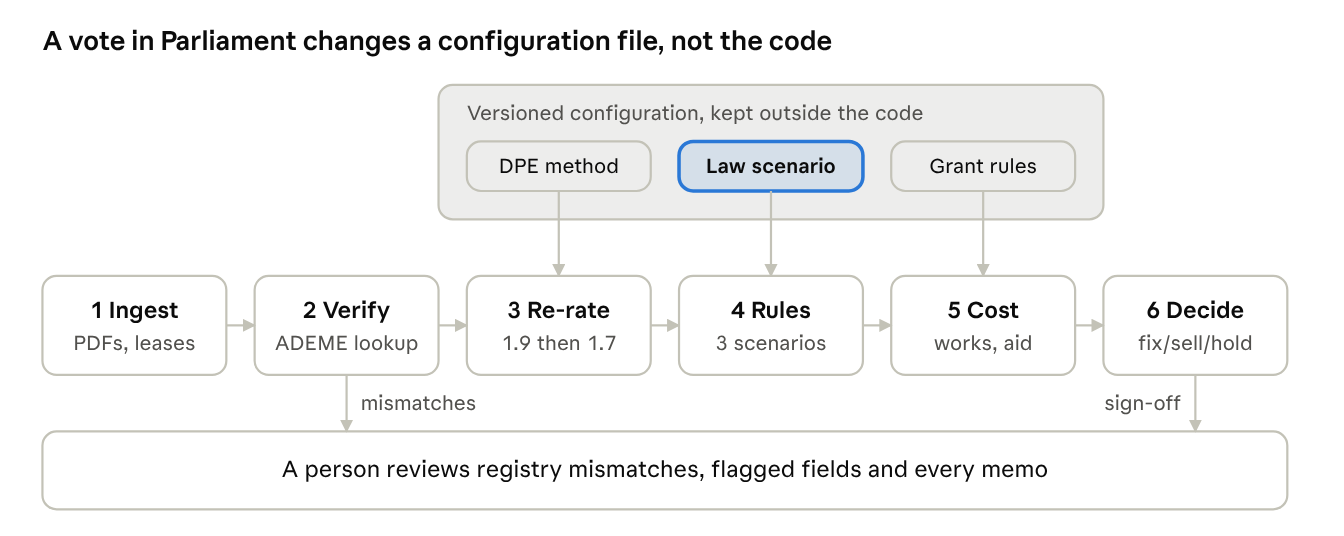
Each configuration input feeds one stage: the DPE method feeds re-rating, the law feeds the rules, and the grant rules feed costing. Change one and the portfolio re-runs without a rebuild.
- Ingest. Start from a rent-roll export from your management software, then add each unit's DPE and lease. For a co-owned building, add the collective DPE and the latest general-meeting minutes. A language model reads what no registry holds: the works each DPE recommends, and each lease's type, landlord entity, renewal date and rent. Every field keeps a page reference.
- Verify. Do not extract what you can look up. Read the ADEME number off each DPE and pull the structured record from ADEME's open data, which covers DPEs issued since July 2021 under an open licence (data.gouv.fr). Mismatches between the PDF and the registry go to a review queue, and older DPEs are flagged as void. Repeat the lookup on a schedule, because a newer DPE replaces an older one.
- Re-rate. Recompute primary energy from the final-energy figures for each fuel, under the current coefficient and under 1.7. Apply both thresholds, energy and emissions, because the worse of the two sets the class. Mark any unit close to a threshold as uncertain. The estimate shows which ADEME attestations to download, and the attestation then replaces the estimate.
- Apply the rules. For each scenario, compute the unit's status and its exposure date: the first new lease or renewal on or after the cut-off. Compute the sale clock too, because selling an unfurnished flat vacant requires notice six months before the lease ends (PAP). This stage is plain code with tests. A language model never decides a legal status.
- Cost the options. Price the works the DPE recommends as a range, first with benchmarks and then with contractor quotes. Net off the grants, which for MaPrimeRénov' means choosing which three units per landlord should claim. Set the result against the sale discount and the rent at risk.
- Decide and explain. Output one line per unit: a recommendation to fix, sell or hold under each scenario, with the numbers behind it and a source for every figure. Store the configuration version with each run, so that last month's answer can be reproduced. A model drafts the memo and a person approves it. A property manager gets one memo per landlord, which also records the advice given.
Leases carry tenants' names, so this is personal data under the GDPR. The landlord or manager stays the controller, and whoever builds and runs the pipeline acts as a processor under a written agreement. Extract only the fields the triage needs. Keeping storage and model calls on EU infrastructure avoids the question of transfers outside the EU.
Where AI helps, and where a person signs
AI does the reading, the estimating and the drafting. The official class, the price of works and the decision each belong to a named person.
| Task | What the AI does | Who signs off |
|---|---|---|
| Reading DPEs and leases | Extracts each field with a page reference, and flags any field where two independent readings disagree | An analyst checks the flagged fields and a sample of the rest |
| The energy class | Estimates the class under each coefficient | Only a certified diagnostician's DPE, or ADEME's attestation, counts |
| Works and prices | Proposes packages from the DPE's recommendations and cost benchmarks | A certified (RGE) contractor's quote, and the mandatory adviser for a MaPrimeRénov' file |
| Lease status | Applies the configured rule to the lease dates | Your lawyer or property manager, above all in co-owned buildings |
| Fix, sell or hold | Ranks the units and drafts the memo | The landlord |
Build this, or buy it
Platforms already turn a single DPE into a costed works scenario. Optimmo, whose study is cited above, is one. If you hold five units, use one of them.
A build earns its place when the answer depends on data only you hold: lease clocks, landlord entities, the allocation of grants between landlords, and the report format your clients expect. The two also combine: a costing platform can feed stage 5 while the pipeline handles the rules and the reporting.
A realistic 4 to 8 week build
The first useful output, an exposure list for a pilot of 10 to 20 units, lands in week 4. The full fix, sell or hold list for a larger portfolio, with several landlord entities and co-owned buildings, takes closer to eight. Our guide to what fits a 4 to 8 week build covers the scoping in general. This is familiar ground for us: we have built a pricing model for a US proptech company.
- Week 1: data audit. Gather DPEs and leases for the pilot units. Done when every unit has a valid DPE number or a diagnostic booked.
- Weeks 2 and 3: extraction and registry check. Done when the fields match the ADEME record on the pilot units, every mismatch is explained, and a hand-checked sample of leases reads correctly.
- Week 4: rules engine. The three scenarios, as configuration, with tests. Done when your lawyer or property manager agrees with the status and exposure date on a sample.
- Weeks 5 and 6: costs and grants. First fix, sell or hold list. Done when two contractor quotes fall inside the model's range.
- Weeks 7 and 8: full portfolio and hand-over. Memo generation, review queue, documentation. Done when you can switch scenario and get a new list in minutes.
What stretches the timeline is rarely the AI. It is missing DPEs, leases held by an outside manager, and co-ownership minutes nobody has filed. Start from a spreadsheet export of the rent roll. A live connection to the management software can wait.
Questions landlords ask
Does the 2028 rule apply to a tenant already in place? Not in mid-lease. It applies to a new lease, and to the first renewal or tacit renewal after 1 January 2028.
Can a G-rated home still be let today? Not on a new lease, a renewal or a tacit renewal, since 1 January 2025. That stays true until a new law is promulgated.
Is a new DPE needed after the January 2027 recalculation? No. A DPE issued since July 2021 stays valid for ten years. If the new coefficient improves the class, a free ADEME attestation replaces the old one.
What if the co-ownership refuses the works? Under current law, a judge cannot order works if the landlord shows they pushed for them and the class still could not be reached. The rent freeze stays. The minutes of the general meetings are the obvious evidence.
What does selling involve? To sell an unfurnished flat vacant, notice is due six months before the lease ends. A house or a single-owner building in class E, F or G also needs an energy audit, which costs €250 to €700 on average. A flat in a co-owned building does not (PAP).
Bottom line
- If the calendar survives, every F-rated unit needs a plan before its first new lease or renewal after 1 January 2028. For some, that is January 2028 itself.
- If it is softened, re-letting depends on a works contract, and choosing which units deserve one is the same analysis.
- If it is repealed, the class still sets the sale price and, as the text stands, keeps the rent frozen. The method also changes again in January 2027.
In all three cases the first step is the same: know each unit's current class, its lease clock and its cheapest route to class E or D.
If you manage 20 or more units in France, send us 10 DPE numbers and the matching lease renewal dates. No documents or tenant data are needed. We will return a one-page triage under all three scenarios, free of charge. It is a reading of public data, not a legal opinion. Submit a project or write to bonjour@arubhardwaj.eu.
This post is general information, not legal, tax or financial advice. Check your own situation with a qualified lawyer, your property manager or a France Rénov' adviser.
Sources
All pages were opened on 25 November 2026.
- Ministry of Ecology: rental ban and rent freeze for energy-inefficient homes
- LCP: the Assemblée adopts the housing bill, 24 November 2026
- NosParlementaires: what deputies changed before the solemn vote
- Immover: amendment 85 and the timetable
- Selectra: what the Senate voted on 8 July 2026
- SDES: housing stock by energy class at 1 January 2025
- MoneyVox with AFP: G-rated private rentals
- Notaires de France: green value of homes, 2024 sales (copy hosted by Actu-Environnement)
- Batiweb: Optimmo's simulation of Paris renovation costs
- Service Public: MaPrimeRénov'
- Service Public: the DPE
- Immo Matin: electricity coefficient 1.7 from 1 January 2027
- data.gouv.fr: ADEME's DPE API
- European Commission: Energy Performance of Buildings Directive
- Assemblée nationale: written question 8910 on DPE reliability, 2023
- Portail DPE: current law, committee text and amendment 85 compared
- Les Tutos de l'Immo: what amendment 85 changes and the next steps
- PAP: legal length of an unfurnished lease
- Immobilier Loyer: MaPrimeRénov' for landlords
- Hello Watt: the F and G rental ban, its triggers and sanctions
- MySweetImmo: Bien'ici rental market observatory, first half of 2026
- LCL: doubled rental-deficit cap extended to 2027
- Opera Energie: the collective DPE
- La Prime Énergie: MaPrimeRénov' Copropriété
- Ministry of Ecology: DPE thresholds for small homes
- Que Choisir: the 140,000 homes helped by the 2024 DPE change
- PAP: the energy audit required to sell a house